

This article explores how AI is being used to advance financial inclusion, with a focus on mobile banking, microcredit, and community-driven systems. Real-world examples, performance metrics, and implementation guidance are included to help stakeholders take action.
The Financial Inclusion Gap
According to the World Bank Global Findex, 1.4 billion adults do not have access to a bank account. The majority live in rural or informal economies, where traditional banks hesitate to operate due to verification challenges, poor infrastructure, and thin credit files. Mobile adoption, however, is high, opening doors for digital-first financial systems.
AI-Powered Mobile Banking: A Digital Entry Point
Voice Assistants and Multilingual Chatbots
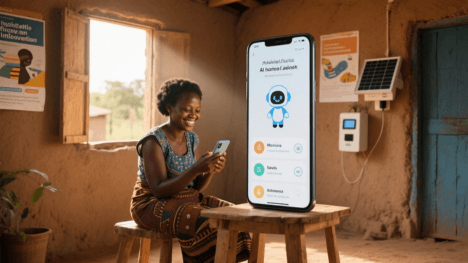
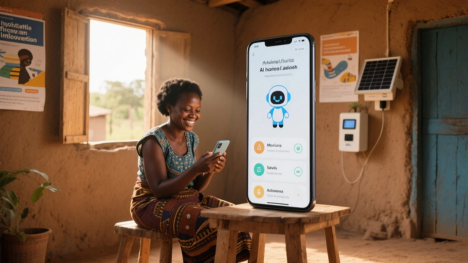
AI-driven chatbots and voice assistants provide low-cost financial services via SMS, WhatsApp, and basic smartphones. These systems use Natural Language Processing (NLP) to support regional dialects and audio input, enabling financial education and account services for users with limited literacy.
Hello Paisa offers cross-border remittances via voice-based interfaces. Viamo uses AI to deliver financial tips and alerts via interactive voice response, supporting users across rural sub-Saharan Africa.
Digital ID and Fraud Detection
Biometric AI models reduce onboarding friction. India’s Aadhaar-linked mobile banking system verifies users through facial recognition or fingerprints, linking them to welfare disbursements. AI also helps prevent fraud by detecting unusual patterns in transaction timing, amounts, or locations.
Smarter Microcredit Through Alternative Data
Traditional credit bureaus require formal income and repayment history. AI enables alternative credit scoring using unconventional but relevant behavioral signals.
How It Works: Tala’s Credit Scoring Engine
Data Collection: Smartphone metadata such as call duration, texting patterns, GPS movement, and app usage
Feature Extraction: Social trust metrics, purchase behavior, and contact frequency
Machine Learning Prediction: Models estimate repayment probability within seconds
Operating in Kenya, the Philippines, and India, Tala has provided loans to over 6 million users with no formal credit history. According to internal metrics, repayment rates improved by 20 percent over three years of iteration.
Suggested Infographic: AI credit scoring pipeline: Smartphone data → Behavioral analysis → Credit decision → Disbursement
Impact in Action: Musoni System, Uganda
The Musoni System combines weather data, crop analytics, and mobile usage to support agricultural microloans. In 2023, its platform disbursed over 10,000 loans across Uganda and Rwanda. Farmers using Musoni saw a 30 percent increase in repayment rates due to AI-informed risk profiling and SMS-based reminders.
Reaching Underserved Populations: Tailored AI Applications
Cultural Adaptation
In West Africa, AI systems are being trained to understand communal lending norms, where responsibility is shared among group members. Models are adapted to recognize repayment behavior that reflects group dynamics rather than individual performance.
Latin America: Nubank in Brazil
Nubank uses AI to provide credit to millions of Brazilians traditionally excluded from formal finance. By analyzing digital behavior, including bill payments, mobile usage, and e-commerce habits Nubank extended credit access to over 5 million favela residents since 2022.
Predictive Risk Tools
Development banks use AI to predict region-level risks such as crop failure, inflation, or political instability. These models inform contingency planning and adaptive lending frameworks. The Inter-American Development Bank integrates AI into its rural finance initiatives to assess systemic vulnerabilities.
Building Financial Trust and Literacy
Adaptive Education Tools
Apps like Juntos use AI to customize financial education via SMS. Content is tailored to the user’s behavior, sending relevant tips only when needed. Users who interact with the app for three weeks show a 25 percent increase in financial confidence.
Gamification and Sentiment Tracking
Financial literacy programs like DreamStart Labs gamify savings plans and loan tracking. AI analyzes sentiment and engagement to refine the curriculum and suggest follow-up interventions.
Suggested Chart: Impact of AI-enabled education tools on savings behavior by region (Africa, South Asia, Latin America)
Responsible AI: Ethics, Bias, and Compliance
Deploying AI in vulnerable populations requires stringent oversight. NGOs and development banks are increasingly adopting ethical AI frameworks.
Bias Audits: Tools like IBM AI Fairness 360 detect gender or ethnic disparities. In one pilot, an AI model was adjusted after it was found to score women-led microbusinesses 15 percent lower than men. The revised model improved equity without sacrificing performance.
Explainability: Simple scoring summaries, built using tools like LIME, help users understand loan approvals or denials.
Regulatory Alignment: Models must comply with local and international standards, including GDPR, which requires data minimization and explicit consent. Role-based access controls and data anonymization are widely adopted to ensure compliance.
Guidance for NGOs and Low-Tech Environments
Even NGOs with limited technical capacity can deploy AI using low-code platforms and public models:
RapidPro: Open-source tool for creating rule-based workflows and chatbots
Google Teachable Machine: Simplifies model training without programming
Model Templates: Fintech partners often offer pre-trained models for deployment in local contexts
Conclusion: AI as a Force for Financial Equity
AI’s promise in financial inclusion lies in its flexibility. It can adapt to non-traditional data, communicate in diverse languages, and operate where branches cannot. But true inclusion requires listening as much as predicting. When communities shape the tools they use, AI becomes not just efficient, but empowering.
“AI in financial inclusion isn’t just about algorithms, it’s about rewriting the rules of access for those left behind.”
- Fintech Innovator, Nairobi
Call to Action
Download our Financial Inclusion AI Toolkit to access:
Microloan scoring templates and bias audit frameworks
Regional case studies from Uganda, Brazil, and the Philippines
A webinar on replicating Musoni’s 30% repayment boost
A live demo of Tala’s credit-scoring engine